Bring your brand to life without rebuilding the foundations. Razorblok combines reusable visual components, a Next.js technical foundation and structured Storyblok integration to help your teams turn ideas into websites faster.
Explore six foundations for your next project: flexible page composition, performance, accessibility and responsible design, SEO readiness, connected content and room to scale. A practical head start you can adapt to your needs and keep building on.
Your brand, assembled from reusable building blocks
Move from a blank page to a coherent website with visual components already connected to Storyblok. Adapt their appearance to your brand, combine them into different page layouts and give editors a consistent way to create content.

A non-exhaustive selection of the available building blocks:
Page composition: image-and-text sections, promotional pushes, teasers, cards and card containers, rich-text paragraphs, taglines and calls to action.
Media and proof points: image carousels, client logo carousels, video and audio players, quotes and animated key figures.
Structured information: accordions, FAQ sections, tables, articles and author profiles.
Interaction: form builders with text inputs, checkboxes, radio groups and selection lists, plus modal triggers and modal content.
Shared components help keep content and presentation consistent across pages. Brand adaptation and any project-specific components remain part of implementation; the library is a starting point, not a limit.

Your identity, without starting from scratch
Keep your design ambitions while reusing the technical foundations. Razorblok combines a Next.js App Router application with server-rendered content, responsive image optimization and shared data-fetching patterns, so teams can focus on the experience rather than recreate the plumbing.
Performance mechanisms, with a clear distinction between the starter kit and deployment choices:
Server rendering and React Server Components: render content on the server where appropriate and reserve client-side JavaScript for interactive features.
Request reuse and caching: React cache wrappers reuse shared fetches within a render; settings use Next.js fetch caching with a one-hour revalidation interval. Preview and published content are requested separately.
Incremental Static Regeneration (ISR): Next.js supports rebuilding eligible cached pages without a full-site rebuild. Actual page caching and revalidation depend on route behavior and hosting; draft-mode access means ISR should not be assumed for every route.
Image and font delivery: next/image supplies responsive image sizing and lazy loading in image-and-text sections; next/font manages font delivery with a swap display strategy.
CDN delivery: Storyblok exposes content through its Content Delivery API and serves assets from its asset delivery domain. Caching the rendered website at the edge requires an appropriate hosting/CDN configuration.
Measure the complete experience: Core Web Vitals, Lighthouse, page weight and third-party scripts should be checked against representative pages. Results depend on content, integrations, traffic and deployment, not just the framework.
Make accessibility and responsible design part of the brief
Build inclusion and digital sobriety into the project from the start. Reusable components provide a shared foundation for semantic structure, keyboard interactions and controlled media delivery. Compliance still needs to be assessed on the assembled website, with its actual content and brand design.

Accessibility and ecodesign goals — to be confirmed through assessment:
Accessibility: target more than 80% compliance with the applicable accessibility criteria. The reference standard, audit scope, sample pages and assessment date must be specified before presenting this percentage as an achieved result. This is not a claim of full RGAA or WCAG compliance.
Assessment priorities: heading structure, meaningful alternatives for images, keyboard navigation, visible focus, contrast, form labels and errors, and accessible behavior for carousels, media and modals. Combine automated checks with manual and assistive-technology testing.
Ecodesign: aim for a B rating under a named assessment method. The tool, pages tested, device and measurement conditions still need to be documented; no independently verified B rating is asserted here.
Practical levers include right-sized images, limiting unnecessary JavaScript, avoiding unnecessary autoplay, controlling third-party services and reviewing content weight. Brand customizations and editorial choices must be reassessed before launch.

Give organic discovery a solid technical foundation
Start with SEO essentials wired into the publishing flow. Page-level metadata, canonical URLs, crawl directives and a generated sitemap provide the technical foundations for discovery, while server-rendered content makes the page available beyond client-side interactions.
SEO foundations already connected to the content model:
Editable SEO titles and descriptions: Storyblok fields feed the Next.js Metadata API, so editors can tailor each page's search presentation.
Canonical and indexing signals: route-based canonical URLs and the page's noIndex setting help describe which pages should be indexed.
Discovery and sharing: a sitemap is generated from published stories, excluding designated non-public content and noIndex pages; Open Graph and Twitter metadata reuse the page's title and description.
Organic growth still needs editorial work: clear page intent, useful content, meaningful headings, internal linking and relevant image alternatives. During replatforming, verify URL changes, redirects and indexability.
These foundations support SEO work; they do not guarantee rankings, traffic or conversions. Structured data, hreflang, analytics and other advanced requirements should be scoped and validated for each project rather than assumed to be included.
A content model your teams can build on
Start with a content structure already connected to the frontend: pages contain reusable blocks, and nested models organize more complex content. Editorial fields and rendering components work together, giving teams a practical base for structured contribution instead of a CMS integration to build from zero.
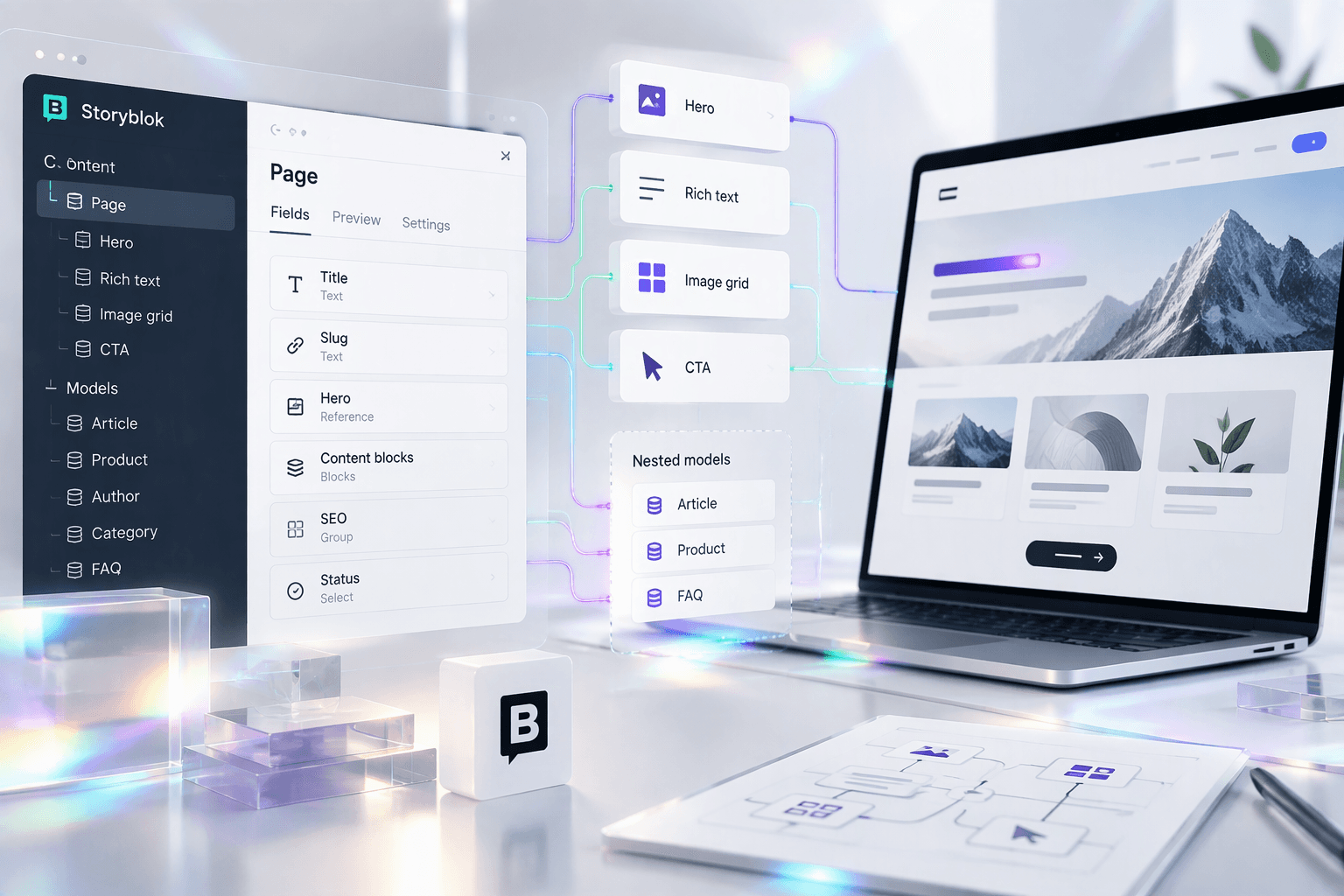
Structured content, practical editing and a clear integration boundary:
Reusable page composition: the Page body accepts mapped components such as TextImage, Push, Paragraph and CTA; specialized nested models organize FAQ sections, questions and form fields.
Editorial guidance: component schemas define field types, required values, length limits and allowed nested components where configured. This helps authors contribute content within a shared structure.
Visual editing: storyblokEditable attributes identify blocks for the Visual Editor, while preview routes request draft content separately from published content.
Connected assets and links: asset fields carry image metadata, and story links reference content entries rather than relying only on manually typed paths.
Room for project-specific modeling: extend the existing schemas and component registry for new needs. Content governance, permissions, localization and publishing workflows should be agreed for the project; a starter model is not a universal or final model.
A starting point, not the finish line
Razorblok is a starter kit designed to shorten the route to a first release, not to define the limits of your website. Launch from a shared foundation, then build the components, content models and integrations that make the experience your own.
Build on the kit as your product and organization evolve:
Extend the experience: introduce new components, adapt existing ones to your design system and create page structures for new use cases.
Connect your ecosystem: plan integrations with search, CRM, commerce, analytics or other business services as project work. These are extension opportunities, not a list of preinstalled connectors.
Scale delivery deliberately: choose hosting, CDN policies and cache strategies to match your traffic and publishing patterns. Load testing, monitoring and capacity planning remain part of production readiness.
Release progressively: start with a focused scope, collect feedback and expand. Keep accessibility, SEO and performance checks in the delivery process as the website grows.
The promise is a reusable head start and a foundation to own and extend, not a fixed end product or unlimited capacity without engineering work.
Your next website with Storyblok built by Razorfish is “already ready”.